Choosing the wrong forklift costs more than the price difference between models. It shows up as slow pallet turnaround, damaged racking, overheated engines in August and operators who never feel safe on the truck.
This guide covers the main types of forklift trucks, what their specifications mean, and how to match a truck to Saudi working conditions. We have supplied and serviced material handling equipment across the Kingdom for decades, so we focus on what holds up in a real warehouse, factory or construction yard.
In brief
- Indoor warehouse work usually points to electric trucks such as reach trucks, pallet stackers and very narrow aisle trucks.
- Outdoor, construction and heavy industrial work usually points to diesel or internal combustion trucks with pneumatic tyres.
- Always check capacity at the load centre, lift height, aisle width and tyre type before you buy.
- In Saudi Arabia, heat, dust and after-sales support matter as much as the spec sheet.
What Is a Material Handling Forklift Truck?
A material handling forklift truck is an industrial vehicle that lifts, moves and stacks loads on forks, usually on pallets. It is one of the most widely used pieces of material handling equipment in any supply chain.
You will also hear the term “material handler”. It can mean the machine, or the operator running it. Either way, the job is the same: moving goods safely from one point to the next with as little manual effort and product damage as possible.
Forklifts differ in power source (electric, diesel or gas), wheel layout, mast design and the environment they suit. Those differences are what separate one forklift type from another.
Main Types of Forklift Trucks at a Glance
| Forklift type | Typical power | Best for | Typical Saudi use |
| Pallet trucks | Electric or manual | Short horizontal pallet moves | Loading docks, retail backrooms |
| Pallet stackers | Electric | Stacking in tight spaces | Small warehouses, mezzanines |
| Reach trucks | Electric | High racking, narrow aisles | Distribution centres, cold stores |
| Very narrow aisle (VNA) trucks | Electric | Maximum storage density | Large warehouses, 3PL facilities |
| 3 & 4 wheel electric forklifts | Electric | Indoor and covered work | Factories, food and beverage plants |
| Tow tractors | Electric or IC | Towing trailers and carts | Factory lines, airports, large sites |
| Compact internal combustion trucks | Diesel or gas | Mixed indoor and outdoor work | Yards, workshops, loading bays |
| IC pneumatic tyre trucks | Diesel or gas | Outdoor and uneven ground | Industrial yards, building materials |
| High capacity forklift trucks | Diesel | Very heavy loads | Steel, precast, port-side handling |
| Rough terrain forklift trucks | Diesel | Unprepared, sandy or rocky ground | Construction sites, quarries |
Different Types of Forklift Trucks and Where They Work Best
Warehouse and picking trucks
Pallet trucks are the simplest piece of equipment on the floor. They move pallets over short distances, and powered versions save operators a lot of effort across a long shift.
Pallet stackers add a mast, so you can lift pallets onto racking at modest heights. They suit smaller warehouses where space is tight and a full forklift would be overkill.
Reach trucks extend the mast or forks forward so the truck can place pallets high in the racking without needing wide aisles. They are an indoor truck, built for smooth floors. If your warehouse stores goods high and the floor is clean and level, this is usually where the conversation starts.
Order pickers raise the operator together with the load, so a picker can pull individual cartons or cases directly from racking. They are a good fit for e-commerce and retail distribution, where picking speed and accuracy drive the whole operation.
Very narrow aisle (VNA) trucks
When storage space is expensive, VNA trucks let you narrow the aisles and add more racking in the same building. This is where Bendi and Drexel are especially relevant.
- Bendi trucks are articulated. The front section bends, so the truck can stack in a very narrow aisle and then drive straight out of the aisle and outdoors on paved ground. That makes one machine capable of unloading a trailer and putting the pallet in its rack position.
- Drexel SwingMast trucks pivot the mast through 90 degrees. They work as a side loader in the aisle and as a front loader at the dock, which is very useful for long loads and mixed pallet storage.
Both are made under the Landoll name, and both let a warehouse use its cube space more efficiently than a conventional counterbalance truck.
Electric forklift trucks: 3 wheel and 4 wheel
3 wheel electric forklifts have a tight turning circle, which suits busy, congested factory floors and loading areas. 4 wheel electric forklifts are generally steadier with heavier loads and give a smoother ride across longer routes.
Electric trucks are quiet, produce no exhaust at the point of use and have fewer moving engine parts to maintain. That is why they are the usual choice for food, pharmaceutical, packaging and general factory work.
Tow tractors
Not every load needs lifting. Tow tractors pull trains of trolleys or trailers, which makes them useful for moving components around a large factory or between buildings on an industrial site.
Internal combustion (IC) forklift trucks
Compact internal combustion trucks are smaller and easier to manoeuvre, so they work well where space is limited but you still need to cross between indoor and outdoor areas.
Internal combustion pneumatic tyre trucks use air-filled tyres, which give better grip and cushioning on rough, uneven or dusty ground. They are the everyday heavy duty truck in industrial yards and building materials operations.
High capacity forklift trucks are built for very heavy loads such as steel, large castings, precast concrete and bulky machinery.
Rough terrain forklift trucks have the ground clearance, tyres and drivetrain to keep working on unpaved sites. They are the natural fit for construction projects and quarries.
Why Saudi Arabia Changes the Forklift Decision
A truck that performs well in a mild European warehouse can struggle here. These are the conditions we see affect forklifts across the Kingdom.
- Heat. Summer temperatures in cities such as Riyadh can pass 45°C, and a yard surface is hotter still. Engines, hydraulic oil, tyres and batteries all work harder. Check cooling capacity and battery management before you buy.
- Dust and sand. Fine dust gets into air filters, radiators, mast channels and electrical connectors. Outdoor and construction trucks need good filtration and a disciplined cleaning routine.
- Humidity and salt air. Along the Red Sea and Gulf coasts, Jeddah, Jubail and Dammam operators deal with corrosion, which affects chassis, electrics and chains over time.
- Long working hours. Many sites run multiple shifts. Duty cycle, battery change speed and easy daily maintenance matter more than headline specifications.
- Project scale. Construction, logistics and industrial growth under Vision 2030 put a lot of demand on equipment, so uptime and parts availability are decisive.
Yale, Bendi, Landoll and Drexel are all heavy-duty industrial brands built to a durability standard that suits this environment, and we support them locally. Even so, specify your truck for Saudi conditions. Tell your supplier where the truck will work, how many hours a day, and in what temperature range, and they can recommend the right options.
Diesel vs Electric Forklifts: Which One Do You Need?
| Factor | Electric | Diesel |
| Best location | Indoors, covered areas, clean floors | Outdoors, yards, rough ground |
| Noise and emissions | Low noise, no exhaust at point of use | Louder, produces exhaust |
| Power and load | Strong on most warehouse and factory loads | Strong on heavy duty work and continuous outdoor use |
| Running cost | Lower maintenance, charging infrastructure needed | Fuel and engine servicing costs |
| Heat tolerance | Needs good battery and charging management | Needs good cooling and air filtration |
A practical rule: if the truck lives inside a warehouse or factory, start with electric. If it spends its day outdoors on construction, mining industry or heavy industrial sites, start with diesel. Many operations use both, with electric trucks inside and a diesel or rough terrain truck handling the yard.
Forklift Truck Specifications: What to Check Before You Buy
Specifications look like a wall of numbers, but only a handful change your decision.
| Specification | What it tells you | Why it matters |
| Rated capacity | Weight the truck can lift at a given load centre | Capacity falls as the load centre moves out, so check the figure at your actual load |
| Load centre | Distance from fork face to the load’s centre of gravity | Long or bulky loads reduce effective capacity |
| Lift height | Maximum fork height | Must match your racking, with clearance |
| Mast type | Number of stages and free lift | Affects stacking height, visibility and working under low doorways |
| Aisle width | Space needed to stack a pallet | Defines your racking layout and storage density |
| Tyre type | Solid, cushion or pneumatic | Solid for smooth floors, pneumatic for rough ground |
| Power source | Battery type or engine | Drives running costs and where you can work |
| Attachments and options | Side shifters, fork positioners, guidance | Adds versatility and speeds up handling |
| Safety features | Overhead guard, operator restraint, visibility, monitoring | Reduces accident and damage risk |
For a sense of scale, the very narrow aisle ranges give typical figures like these. They vary by model and configuration, so please confirm exact data with our team.
| Model range | Capacity (at 600 mm load centre) | Minimum aisle (approx.) | Maximum lift height (approx.) |
| Bendi 3-wheel articulated | from about 1,360 kg | about 1.8 m | up to about 9 m |
| Bendi 4-wheel high lift | from about 2,000 kg | about 2.0 m | up to about 12.5 m |
| Drexel SwingMast SL range | up to about 2,270 kg | about 1.5 m | up to about 9.5 m |
| Drexel high capacity SwingMast | up to about 5,440 kg | about 1.8 m | about 6 m |
The Brands We Supply, and Why They Suit Saudi Operations
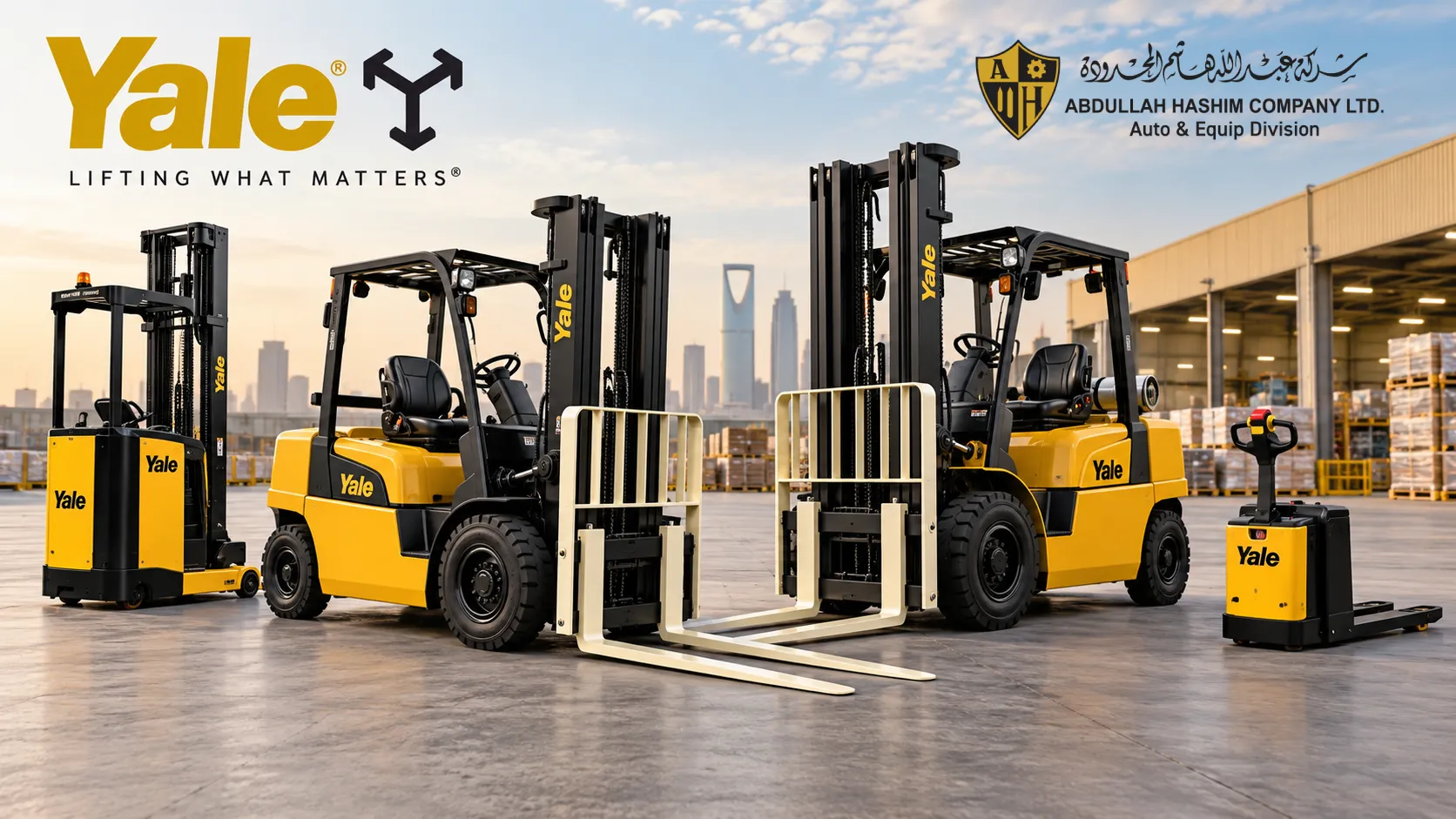
Yale offers one of the broadest forklift and material handling ranges: reach trucks, order pickers, very narrow aisle trucks, pallet trucks, pallet stackers, 3 and 4 wheel electric trucks, tow tractors, and internal combustion, high capacity and rough terrain trucks. Yale also emphasises operator safety, training resources and fleet monitoring tools. Power options such as lithium-ion batteries are available on selected models, so ask us what is available for your application.
Bendi is known for articulated very narrow aisle trucks that handle trailers, narrow aisles and outdoor paved areas with one machine.
Landoll is the engineering group behind the Bendi and Drexel ranges. Features like hydraulic steering and traction control are designed to keep these trucks controllable at height and with heavy loads.
Drexel SwingMast trucks combine front-loading and side-loading in one truck, which is valuable for long loads and tightly packed storage.
AHCL is the exclusive dealer and distributor in Saudi Arabia for these ranges, so you deal directly with the local source for sales, service and original manufacturer spare parts.
Which Industries Use Which Forklift?
- Warehouse and logistics: reach trucks, VNA trucks, order pickers, pallet stackers and pallet trucks.
- Factory and manufacturing: 3 and 4 wheel electric forklifts, tow tractors and compact IC trucks.
- Construction: rough terrain and pneumatic tyre IC forklifts, built for sand, gravel and uneven ground.
- Mining industry and quarries: high capacity and rough terrain diesel trucks for moving supplies, spares and heavy components around yards and workshops.
- Steel, timber and building materials: high capacity trucks and Drexel SwingMast side loaders for long and heavy loads.
- Outdoor yards and ports: IC pneumatic tyre trucks and high capacity trucks built for continuous outdoor use.
Forklift Safety: Getting It Right From Day One
A forklift is only as safe as the way it is chosen, set up and operated.
- Train every operator. Make sure they understand the specific truck they will drive, including its stability limits.
- Respect the load chart. Never lift beyond rated capacity at the actual load centre.
- Inspect daily. Check tyres, forks, mast chains, brakes, lights and hydraulics before each shift, and check cooling and air filters in summer.
- Control the site. Keep clear travel routes, mark pedestrian zones and keep floors and yards in good condition.
- Maintain on schedule. Use trained technicians and genuine parts so safety systems work as designed.
- Follow applicable Saudi regulations and the manufacturer’s operating guidance for your site.
How to Choose the Right Forklift: A Simple 5-Step Check
- Define the loads. Weight, size, pallet type and how heavy the heaviest load is.
- Map the environment. Indoor, outdoor or both, floor condition, ramps, aisle widths and ceiling heights.
- Pick the power source. Electric for indoor, diesel for outdoor and heavy duty, or a mix.
- Check the specifications against your racking and your busiest shift.
- Plan the support. Confirm service coverage, parts supply and training before you sign.
After-Sales Support and Genuine Spare Parts
A forklift is a long-term working asset, so what happens after delivery matters as much as the purchase. AHCL’s dedicated after-sales team and spare-parts network give customers access to original manufacturer parts, and our branch and service centre network covers Jeddah, Riyadh, Dammam, Tabuk, Buraidah, Jubail, Madinah, Hail, Al Hassa, Jizan and Al Kharj.
AHCL began trading in 1945 and has grown into one of the oldest and largest material handling equipment dealers in Saudi Arabia, supplying industrial, construction and warehouse customers across the Kingdom.
Frequently Asked Questions
What are the main types of forklift trucks?
The most common are counterbalance trucks (electric or internal combustion), reach trucks, very narrow aisle trucks, pallet trucks and stackers, and rough terrain forklifts. Each is designed for a different environment and type of load.
Which forklift is best for a warehouse?
It depends on layout and storage height. Reach trucks and pallet stackers suit standard racking, while very narrow aisle trucks give maximum storage density.
Is a diesel or electric forklift better in Saudi Arabia?
Electric suits indoor warehouse and factory work. Diesel suits outdoor, construction and heavy industrial work. Heat and dust make cooling, filtration and maintenance important for both.
What does the load centre mean in forklift truck specifications?
It is the distance from the front of the forks to the centre of gravity of the load. A longer or bulkier load has a larger load centre, which reduces the weight the truck can safely lift.
What is the difference between a pallet truck and a pallet stacker?
A pallet truck moves pallets horizontally. A pallet stacker has a mast, so it can also lift pallets onto racking.
Can one truck work both inside a warehouse and outdoors?
Some can. Articulated Bendi trucks and Drexel SwingMast trucks work in very narrow aisles and on paved outdoor areas. For rough or unpaved ground, a pneumatic tyre or rough terrain truck is the right choice.
Where can I buy genuine forklift spare parts in Saudi Arabia?
Through AHCL’s spare-parts network, which provides access to original manufacturer parts alongside our service teams.
Talk to AHCL About Your Material Handling Requirements
Tell us about your loads, your site and your shifts, and our team will recommend the right forklift types and specifications. We can also provide a quotation and explain after-sales and genuine spare-parts support.
- Call (toll-free): 92000 2208
- WhatsApp: +966 55 164 8106
- Email: machinery@ahcl.com.sa